
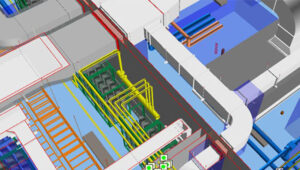
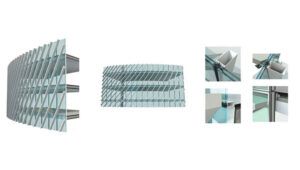
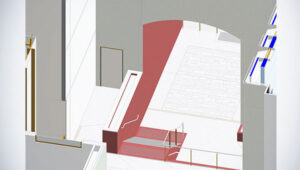
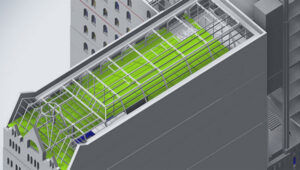

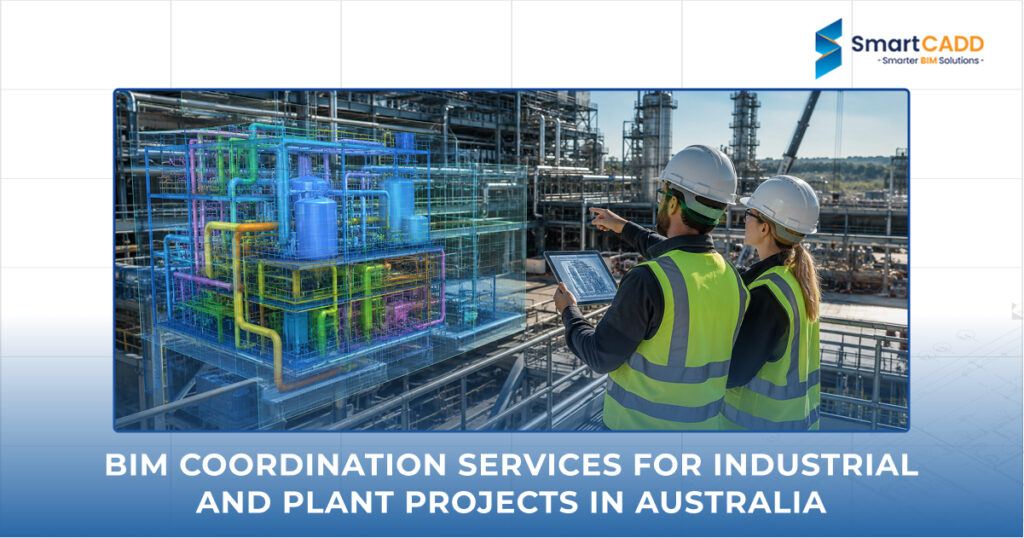

Industrial and plant projects in Australia are some of the most complex builds in the construction world, and that’s exactly where BIM coordination services in Australia make the biggest difference. Whether you’re working on a processing facility, a manufacturing plant, or a heavy industrial site, having all your building systems properly coordinated before construction begins can save you months of delays and millions in rework costs.
Challenges of Heavy Industrial & Plant Construction
Heavy industrial projects are not like regular commercial builds. You’re dealing with large-scale equipment, dense piping networks, high-voltage electrical systems, and structural steel, all running through tight spaces at the same time.
Professionals and labourers from multiple trades working on the same site simultaneously can face problems because of disorganization. Even one misplaced pipe or duct can bring the whole schedule to a halt.
The stakes are high, the tolerances are tight, and the cost of mistakes is enormous. This is why BIM coordination services are no longer optional for industrial projects in Australia. Today, they have become a necessity.
The Step-by-Step BIM Workflow
From the first site scan to the final drawing handover, BIM coordination services follow a structured process that keeps every trade aligned and every system conflict-free.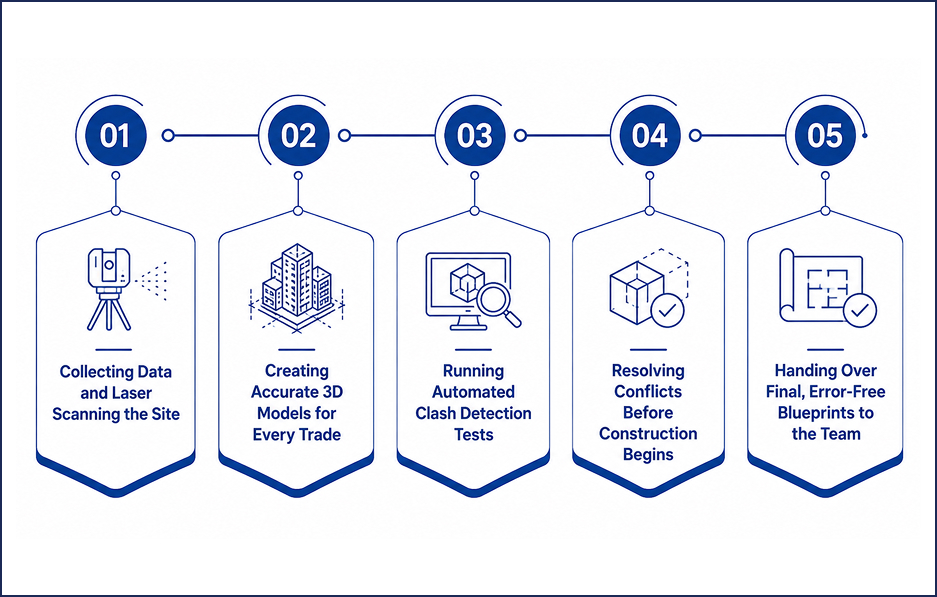
Collecting Data and Laser Scanning the Site
Before any modelling begins, the team captures the existing site conditions using laser scanning technology. This creates a highly accurate point cloud of the real-world environment, which forms the foundation for all further work.
Creating Accurate 3D Models for Every Trade
Using the scan data, detailed 3D models are built for each trade: structural, architectural, mechanical, electrical, and plumbing. Every element is modelled to its exact size and position.
Running Automated Clash Detection Tests
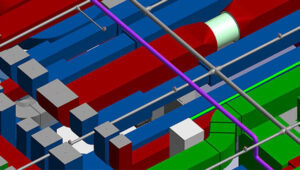
Once all models are combined into a single federated model, automated clash detection software identifies every point where two systems conflict. For example, a duct running through a structural beam or a pipe colliding with an electrical conduit.
Resolving Conflicts Before Construction Begins
Each clash is reviewed, documented, and resolved by the coordination team in collaboration with the relevant trade contractors. All changes are made in the model, not on the construction site.
Handing Over Final, Error-Free Blueprints to the Team
After all conflicts are resolved, clean, coordinated drawings are issued to the construction team. Every trade knows exactly where their systems go, and nothing is left to chance on-site.
Learn how BIM coordination streamlines project workflows by detecting and resolving design conflicts early in the process in our guide on The Role of BIM Coordination in Delivering Clash-Free Models.
How MEP Coordination Services Prevent On-Site Disasters
When it comes to industrial projects, uncoordinated building systems are one of the leading causes of costly delays — and that’s exactly what proper MEP coordination services are built to eliminate.
What is MEP and Why Does It Matter?
MEP stands for Mechanical, Electrical, and Plumbing. These are the three core building systems that keep any industrial facility running. In a plant project, MEP systems are especially dense and complex, often running across every level of the structure.
The Risks of Uncoordinated Building Systems
When MEP systems are not properly coordinated, professionals and labourers’ work ends up clashing on site. This happens when they discover that pipes, ducts, and conduits can’t physically occupy the same space. This leads to costly rework, project delays, and sometimes serious safety hazards. Proper MEP coordination services prevent this from happening.
Maximizing Efficiency Through Strategic Layout Planning
Good 3D MEP coordination doesn’t just avoid clashes. It also optimises the routing of every system for maximum efficiency. This means shorter pipe runs, easier access for maintenance, and better use of available space throughout the facility.
To better understand the role of coordinated building systems, explore our Complete Guide to MEP Coordination in Building Projects.
The Major Benefits of BIM Coordination Services for Project Owners
Investing in BIM coordination services early in a project pays back far more than it costs — in time saved, budgets protected, and headaches avoided.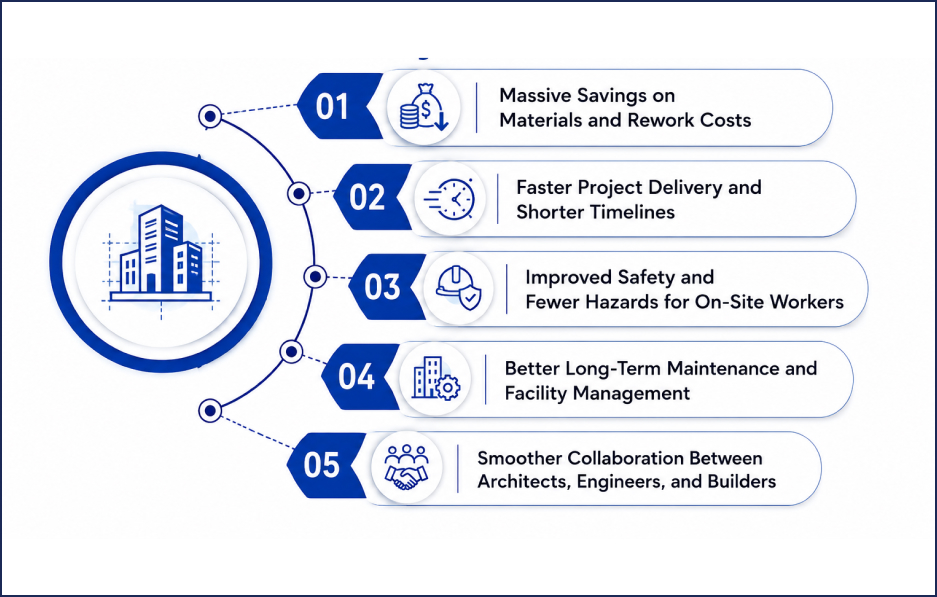
Massive Savings on Materials and Rework Costs
Studies consistently show that BIM coordination services reduce rework costs significantly. When clashes are caught in the model rather than on site, you save on labour, materials, and downtime.
Faster Project Delivery and Shorter Timelines
Coordinated projects move faster because in such projects, trades don’t have to stop and wait for redesigns, and sequencing is planned well in advance. This means your facility gets operational sooner.
Improved Safety and Fewer Hazards for On-Site Workers
A well-coordinated site is a safer site. When everyone knows exactly where systems are installed, there are fewer surprises, fewer errors, and fewer incidents.
Better Long-Term Maintenance and Facility Management
The 3D models produced during BIM coordination don’t disappear after construction. They become a valuable asset for facility management and help your team plan maintenance, identify systems quickly, and manage the building throughout its entire lifecycle.
Smoother Collaboration Between Architects, Engineers, and Builders
BIM coordination services give every stakeholder access to the same shared model. Architects, structural engineers, MEP contractors, and project managers all work from one source of truth, which dramatically reduces miscommunication.
Partnering with SmartCADD for Your Next Australian Project
If you’re looking for reliable MEP BIM coordination services in Australia, SmartCADD brings the expertise, tools, and local market knowledge to get your project delivered right. From the first consultation to the final model handover, we work as an extension of your team, so your project stays on schedule, on budget, and completely clash-free.
Tailored BIM Solutions for the Australian Market
At SmartCADD, we understand the specific demands of the Australian construction industry, like their local standards, project timelines, and the expectations of Australian contractors and project owners. Our BIM coordination services are specifically tailored to meet these requirements, whether you’re building in Sydney, Melbourne, Brisbane, or a remote industrial site.
Why Leading Contractors Trust SmartCADD?
We combine deep technical expertise with a collaborative approach. Our team works closely with every trade on your project to ensure that clashes are resolved quickly and the final coordinated drawings are clear, accurate, and construction-ready. We also provide dedicated MEP BIM coordination services in Australia, covering everything from HVAC and plumbing to fire safety and electrical systems, all under one roof.
Our Proven Track Record in Industrial & Plant Projects
Our company has delivered BIM coordination services across healthcare facilities, data centres, commercial towers, and sports stadiums throughout Australia and beyond. With 120+ completed projects, a 95% repeat client rate, and experience working across 7 countries, SmartCADD brings a level of reliability and precision that industrial project owners can depend on.

Conclusion
Industrial and plant construction in Australia demands a level of precision that traditional 2D drawing processes simply can’t deliver. BIM coordination services bring all your trades, systems, and stakeholders onto the same page digitally, before a single bolt is tightened on site.
From 3D MEP coordination and automated clash detection to final handover documentation, the entire process is designed to eliminate costly surprises and keep your project on time and on budget. If your next project deserves that level of control and confidence, it’s time to partner with a team that knows how to deliver it.

