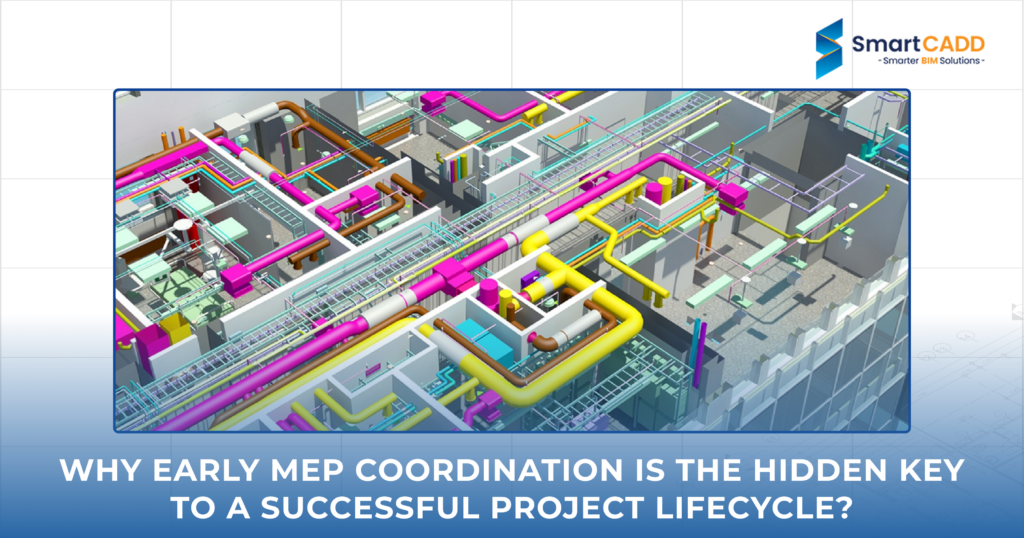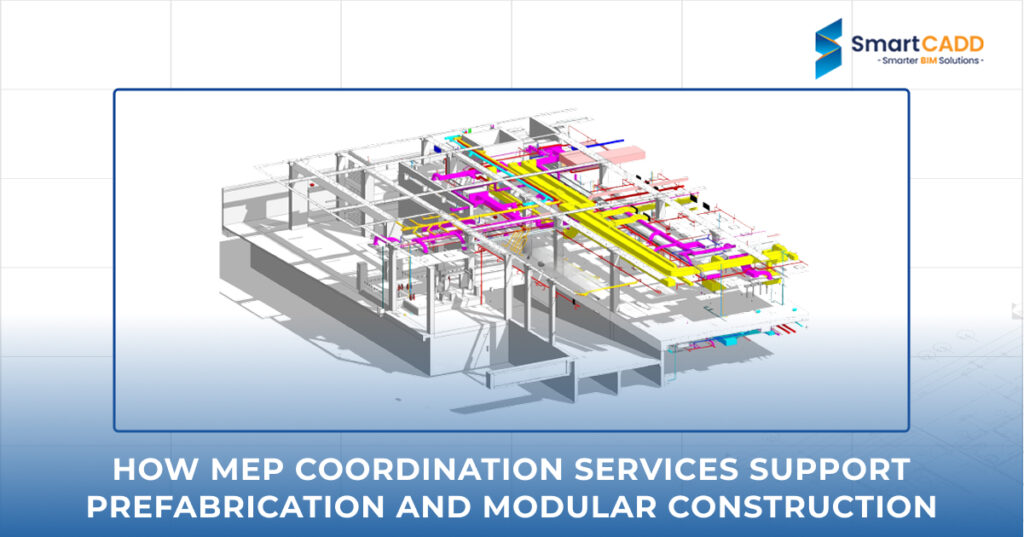
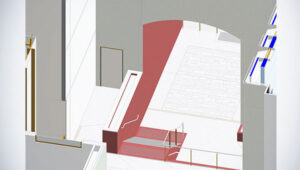
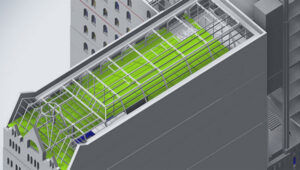
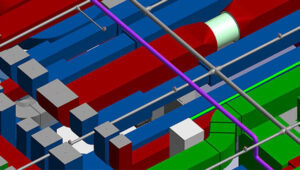



Clashes in BIM models are not just annoying; they are expensive. A large part of these issues comes from poor coordination between mechanical, electrical, and plumbing systems. In fact, according to McKinsey’s report The Next Normal in Construction, an estimated 75% of BIM clashes stem from poor MEP integration. MEP Coordination helps teams spot problems early, before they turn into costly delays on site. It’s not just about avoiding mistakes. A clear model helps teams trust the work and get faster approvals. And in a competitive market, that makes a real difference.
Here’s a basic table comparing the cost of BIM clashes and coordinated models.
Factor | BIM with Clashes | Coordinated BIM Model |
Design Rework Costs | High: multiple revisions needed | Low: issues resolved early |
Construction Delays | Frequent: due to on-site conflicts | Minimal: smooth execution |
RFI Volume | High: many requests for clarification | Low: clear documentation |
Change Orders | Common: unexpected changes during build | Rare: most conflicts are resolved in the design phase |
Labor & Material Waste | Significant: due to rework and idle time | Reduced: better planning and sequencing |
Client Confidence | Low: perceived risk and inefficiency | High: predictable outcomes and transparency |
Approval Timelines | Slower: due to unresolved design issues | Faster: clean documentation and fewer revisions |
Overall Project Cost | Inflated: due to cumulative inefficiencies | Controlled: better budget adherence |
What Is MEP Coordination in BIM?
Understanding the Basics
MEP Coordination is the process of making sure that Mechanical, Electrical, and Plumbing systems fit together in a shared Building Information Model (BIM). It is about spotting conflicts early, before construction starts. It makes everything work as planned.
MEP BIM modeling services facilitate collaboration among various teams. Architects and engineers work from the same model. Contractors use it too, keeping everyone aligned. That reduces errors and helps everyone make better decisions.
For a deeper understanding, check out our Complete Guide to MEP Coordination in Building Projects
Tools & Technologies That Power It
MEP coordination only works when teams use the right tools and follow a clear process.
- It starts with smart components built through Revit MEP family creation. Teams use Revit to design ducts, panels, and pipes that behave like real systems. These aren’t just shapes; they carry data and respond like they would on site.
- MEP 3D modeling helps everyone see how systems fit together. It’s a simple way to catch problems early. If a pipe runs through a beam, you’ll see it before construction starts. It saves time and costs.
- Teams use Revit, Navisworks, and BIM 360 to maintain synchronization. These tools support live updates and clash detection. They also allow teams to review shared models in one place. Everyone works on the same version. No one’s out of sync. Changes are tracked as they happen, so nothing gets lost or repeated.
To explore the coordination aspect in more detail, refer to our MEP Services and it’s role in BIM Services
Why MEP Coordination Prevents Clashes
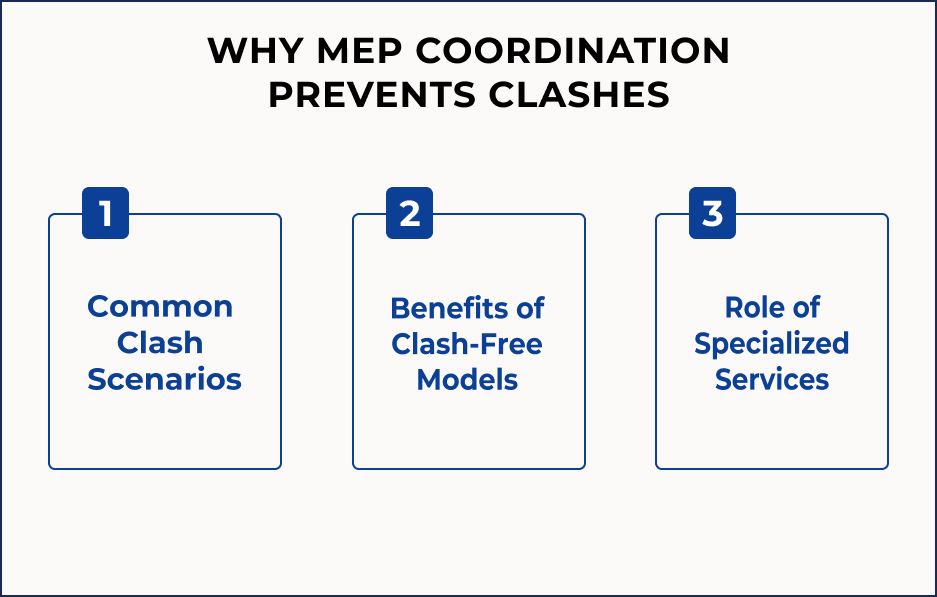
Common Clash Scenarios
Clashes happen when systems overlap or compete for space. Some typical examples:
- HVAC ducts running into structural beams
- Electrical conduits crossing plumbing lines
- Poor layout in tight areas like shafts or corridors
These issues slow down work, increase RFIs, and lead to expensive rework.
Benefits of Clash-Free Models
When models are coordinated, teams avoid surprises on site. The benefits are clear:
- Fewer design changes mean less time spent fixing issues, which helps teams stay focused and move faster.
- Quicker approvals and easier construction.
- More trust from clients and consultants
It also helps teams stick to timelines and budgets.
Discover how coordination planning enhances clash detection and cuts project delays in our Complete Guide to How MEP Clash Detection Services Save Time and Money By Preventing Construction Conflicts
Role of Specialized Services
Specialized MEP coordination services make this easier. They help teams:
- Check designs early and catch errors before construction
- Use MEP clash detection services to spot problems in the model early.
- Stay updated with real-time changes using MEP BIM coordination services across all disciplines.
To understand how effective coordination boosts MEP design efficiency, explore our Complete Guide to How do MEP Design and Drafting Improve building Efficiency
Here is a before-and-after comparison of a clashed vs. a coordinated model
Aspect | Before: Clashed Model | After: Coordinated Model |
System Layout | Ducts, pipes, and cable trays crossing over each other. | Clean, conflict-free routing of all MEP systems |
Design Review | Too many revisions slow things down. | Fewer changes make approvals quicker and easier. |
Construction Workflow | Work gets delayed when clashes aren’t fixed in time. | Smooth execution with clear installation paths |
RFI Volume | High: teams constantly seek clarification | Low: documentation is clear and trusted |
Change Orders | Common: Unexpected site issues force redesigns | Rare: most issues resolved during coordination |
Cost Impact | Increased labor, material waste, and delay penalties | Controlled budget with minimal rework |
Stakeholder Confidence | Low: project seen as risky or poorly managed | High: model reflects professionalism and planning |
Project Timeline | Delayed: clashes slow down progress | On schedule: coordination supports timely delivery |
How to Set Up and Manage MEP Coordination
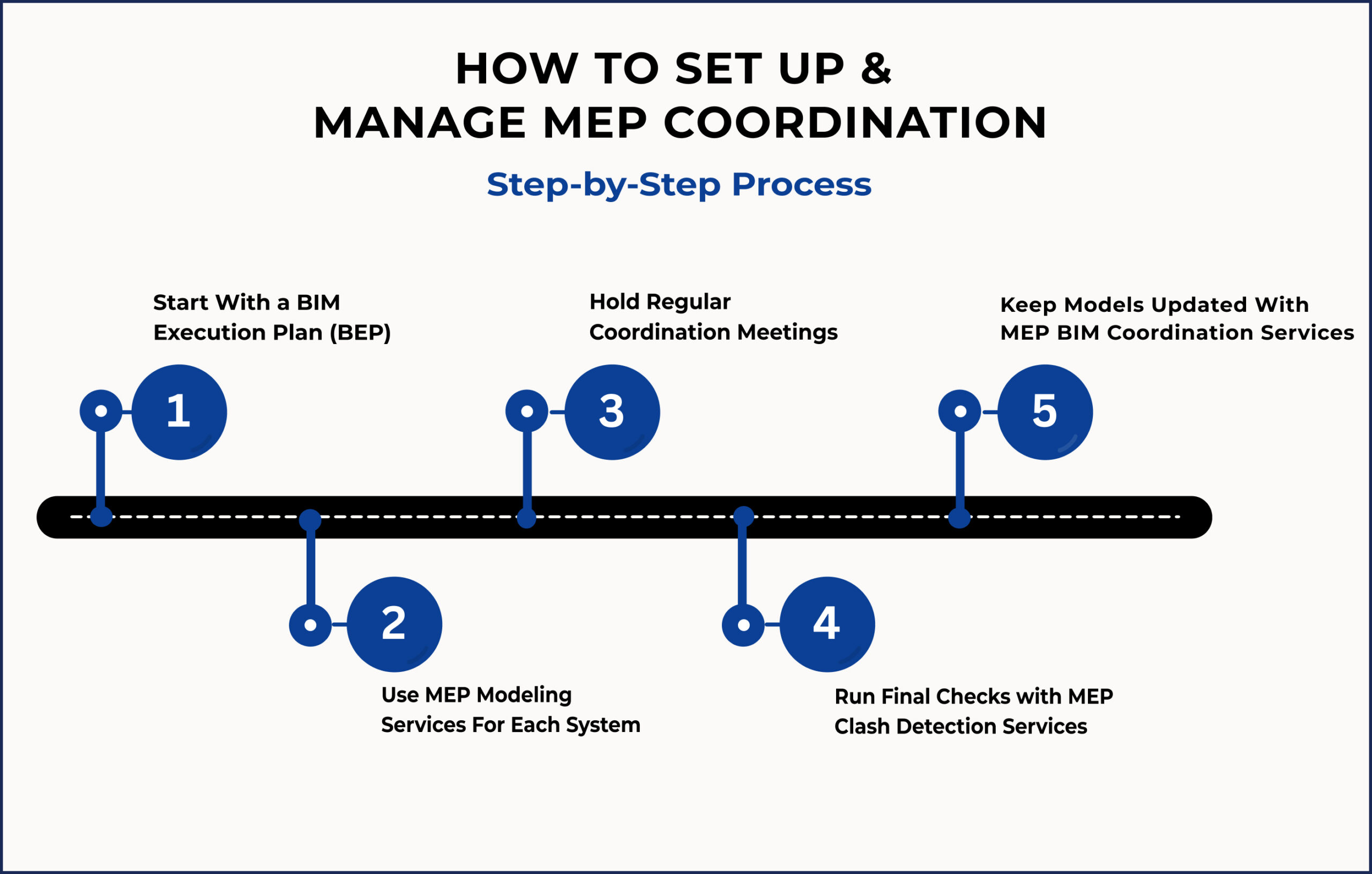
Step-by-Step Process
- Start with a BIM Execution Plan (BEP): It sets tasks and file-sharing rules so everyone works the same way from the start.
- Use MEP modeling services for each system: Bring in detailed inputs for HVAC, electrical, and plumbing. Each system needs its own layer of accuracy. This avoids confusion later.
- Hold regular coordination meetings: Don’t wait till the end to fix problems. Meet often, review the combined model, and check how systems fit together. This helps catch clashes early.
- Run final checks with MEP clash detection services: Use tools to scan for overlaps—like ducts hitting beams or pipes crossing cables. Fixing these now saves time and cost on-site.
- Keep models updated with MEP BIM coordination services: Designs change. Make sure everyone’s working from the latest version. Real-time updates help avoid mix-ups and keep the project moving.
Choosing the Right Partner
What to look for in MEP BIM coordination services
Not every vendor understands how MEP systems work together. Here’s what matters:
- Experienced in coordinating HVAC, electrical, and plumbing. Knows how these systems connect on real jobs.
- Knows how to use clash detection tools like Navisworks.
- Ability to manage shared models and real-time updates
- Clear process for communication and approvals
Look for a team that knows the technical side and can manage daily coordination.
Importance of experience with Revit MEP family creation
Revit families are the parts that make up your model. If they’re built well, everything runs smoothly.
- Custom families reduce errors and speed up modeling
- They help with clash detection and quantity takeoffs
- Clean families make it easier to work across disciplines
Ask for samples. It shows how well they handle detail and consistency.
Questions to ask during vendor selection
Don’t just ask about tools. Ask how they work.
- How do you manage updates when designs change?
- What’s your process for spotting and fixing clashes?
- Can you show examples of coordinated MEP models?
- Do you build custom Revit families or use standard ones?
- How often do you run coordination meetings?
Future of BIM MEP Coordination
Trends to Watch
- AI-powered clash detection: Teams now use AI to spot clashes automatically. It speeds up work and decreases the chances of errors. You don’t have to check everything manually; AI flags the problems early.
- Cloud-based MEP BIM modeling services: Models are now stored in the cloud. Everyone sees the same version, and updates show up instantly. There’s less confusion and fewer delays.
- Integration with digital twins and IoT: MEP models are becoming more connected. With sensors and live data, teams can track how systems perform after construction. This helps spot issues early and plan maintenance better.
Why Engagement Matters
- EEAT+ shift: From expertise to engagement: Technical skill still matters. But it’s not the whole story. Clients want clarity. Reviewers want transparency. The shift to EEAT+ means you’re judged not just on what you know, but how well you communicate it.
- Role of visual dashboards and client-facing reports: People don’t want to read through dense files. Dashboards and reports show progress and highlight issues clearly. They also help teams understand what’s coming next. When visuals are clear, it helps with quick feedback and approvals.
- How MEP 3D modeling helps: MEP 3D models show how everything connects. They help explain design decisions and spot issues early. Stakeholders can see the plan, ask better questions, and stay aligned.
Conclusion
BIM MEP coordination keeps teams on the same page. It cuts confusion, avoids delays, and helps decisions happen sooner. There’s less rework and clashes, and better communication across the board. It’s not just about drawings. It’s about helping everyone see what’s being built and how it all connects. MEP coordination saves time and cuts costs. It also builds trust with clients and keeps projects on track.
If you want to see how this works in practice, check out our portfolio. We’ve documented real workflows, results, and examples that show what good coordination looks like. SmartCADD specializes in BIM MEP modeling services and MEP coordination services tailored for real-world construction needs. From clash detection to fabrication-ready models, their team supports projects with clarity, speed, and technical depth.