

Introduction to Scan to BIM in Healthcare Facilities
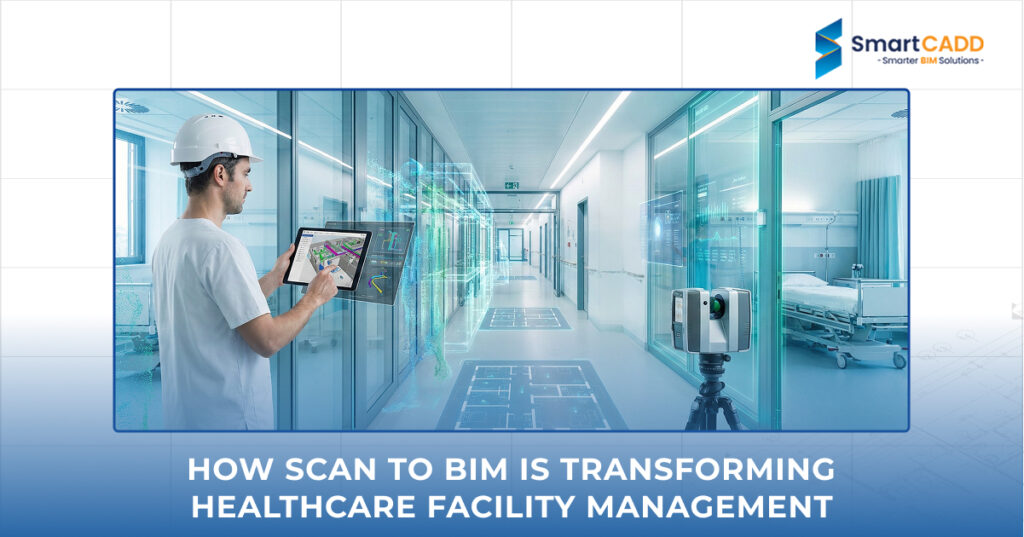
As hospitals continue to expand, modernize, and upgrade medical equipment, maintaining accurate digital representations of their facilities has become essential. Scan to BIM bridges this need by converting real-world building conditions into intelligent digital models that support planning, safety, maintenance, and renovation.
What Is Scan to BIM and Why It Matters in Hospitals
If you’re wondering what is Scan to BIM, the concept is simple: high-precision scanners capture physical spaces, producing detailed point clouds that are later turned into BIM models. These models become a reliable digital foundation for healthcare facility operations.
Hospitals are dynamic environments. Walls move, wards expand, ducts reroute, and medical gas lines shift. Outdated drawings make it extremely difficult to manage renovations or maintenance. That’s where Scan to BIM services provide clarity and control.
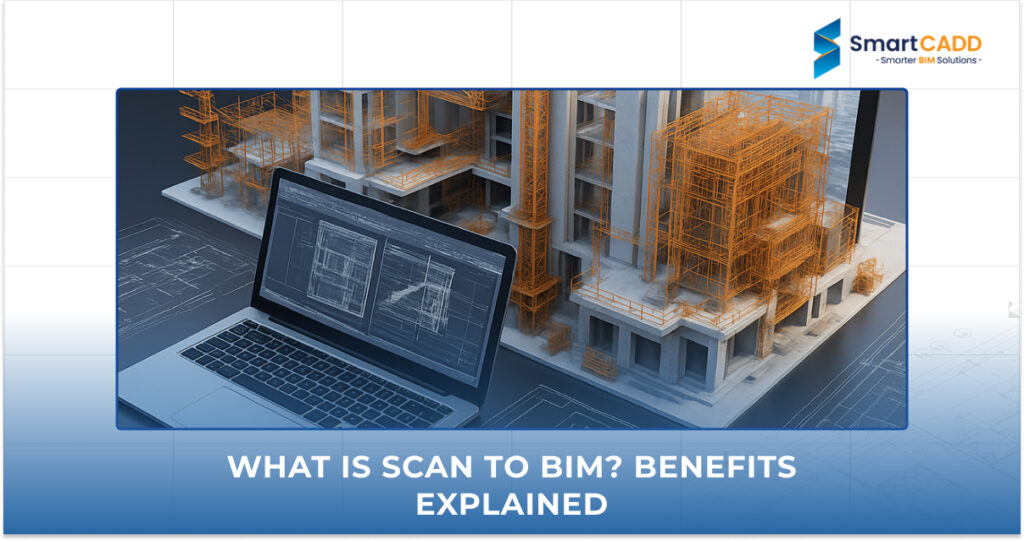
Learn more about the process in our detailed guide: What is Scan to BIM? Benefits Explained.
Why Healthcare Facilities Struggle Without Scan to BIM
Hospitals face challenges that typical buildings do not. They operate 24/7, cannot afford downtime, and house life-critical equipment, utilities, and sensitive spaces.
Complex Layouts and Evolving Medical Infrastructure
Healthcare buildings are full of tightly packed systems: oxygen lines, vacuum systems, emergency circuits, HVAC networks, fire protection, and more. Without accurate bim 3d modeling, locating and maintaining these systems becomes slow and risky.
Facility Downtime and Operational Risks
When construction teams lack updated documentation, they may shut down incorrect systems, drill into active areas, or compromise structural and safety components. This is especially dangerous in ICU, operating theaters, pharmacies, or imaging suites.
Maintenance Challenges Without Accurate As Builts
Many hospitals still rely on paper-based drawings that are outdated or incomplete. Technicians waste hours searching for valves, cables, or duct routes. 3D BIM modeling services replace this guesswork with clarity.
How BIM 3D Modeling Solves This
BIM models created using Scan to BIM services provide technicians with exact locations of assets, enabling quick repairs, upgrades, or safety checks.
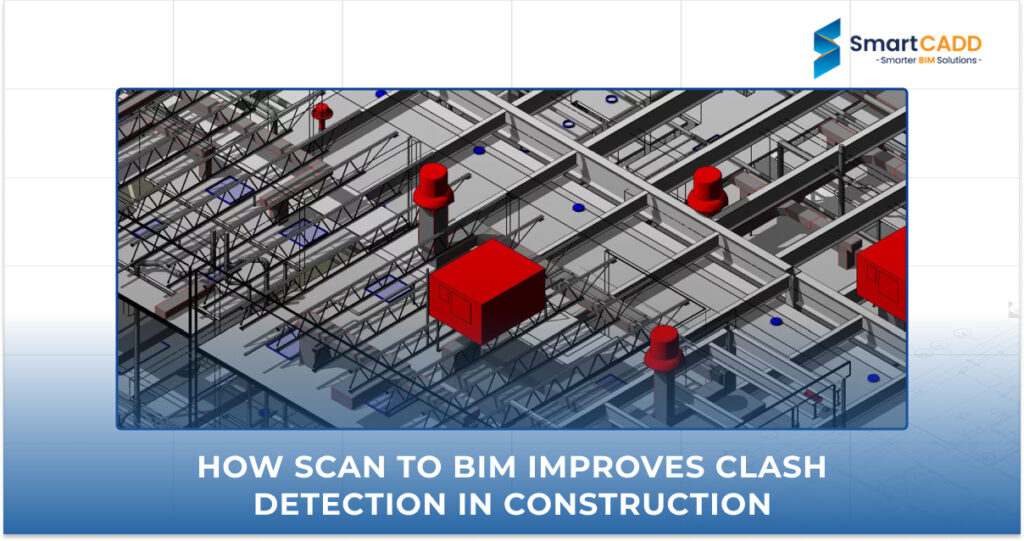
For a deeper look at its impact on project coordination, see our article: How Scan to BIM Improves Clash Detection in Construction.
How Scan to BIM Transforms Healthcare Facility Management
Healthcare facilities across Australia and globally are embracing digital workflows as they recognize the strategic value of BIM-driven maintenance.
Capturing Reality With Laser Scan to 3D Model Workflows
The transformation begins with laser scan to 3D model processes. A scanner captures millions of data points using LiDAR, generating a point cloud that accurately reflects walls, ceilings, equipment, MEP systems, shafts, and more.
For more technical insights, see our article: Understanding LiDAR Technology in Scan to BIM.
The Role of 3D Laser Scanning Teams
In markets like Australia, hospitals often rely on regional specialists such as 3D laser scanning Sydney teams, who have the tools and experience to capture tight spaces accurately while minimizing downtime.
From Point Cloud to BIM Deliverables
Once captured, the point cloud to BIM conversion begins, producing a full architectural, structural, and MEP model that can support:
- Renovation planning
- Equipment upgrades
- Mechanical system optimization
- Energy efficiency analysis
- Facility Management system integration
Enhanced Space Management & Medical Equipment Planning
Hospitals constantly adjust to evolving healthcare demands. Using Scan to BIM, planners can evaluate room sizes, clearances, workflows, and equipment fit before physical work begins.
Safety Compliance & Emergency Planning Improvements
Healthcare facilities depend on strict compliance with:
- Fire exits
- Oxygen storage rules
- Pressure zones
- Hazardous material rooms
With BIM visualization, facility teams can review real-time layouts and ensure code compliance.
Energy Efficiency & HVAC Optimization
With accurate BIM data, engineers can simulate airflows, equipment performance, and heat loads – essential in infection-sensitive areas like operating rooms and labs.
Key Benefits of Using Scan to BIM
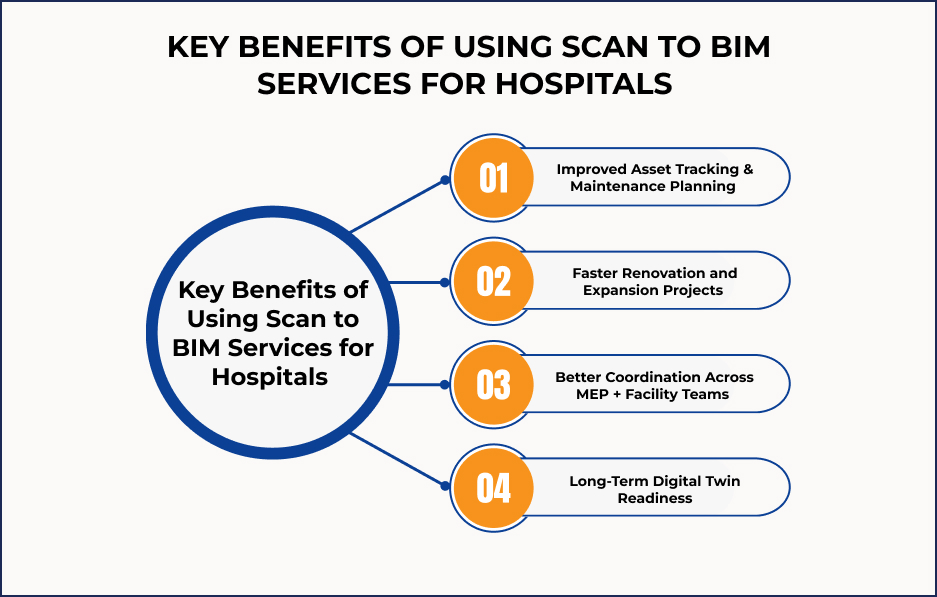
Services for Hospitals
Improved Asset Tracking & Maintenance Planning
Each valve, duct, pipe, and electrical panel can be tagged and tracked through a BIM environment, eliminating guesswork and supporting predictive maintenance.
Faster Renovation and Expansion Projects
Renovations become risky without knowing where systems are located. Scan to BIM services provide a real-time digital twin for safe planning.
Better Coordination Across MEP + Facility Teams
Mechanical, electrical, plumbing, and facility teams can collaborate using the same BIM environment – reducing conflicts and miscommunication.
Long-Term Digital Twin Readiness
Hospitals looking toward smart building technologies rely on digital twins. Scan to BIM is the foundational step to achieve this vision.
How to Select the Right Scan to BIM Services Provider for Healthcare Projects
Why Healthcare Projects Need Specialized Scan to BIM Expertise
Hospitals contain complex systems and sensitive environments. A general BIM vendor may not understand medical gas systems, sterile areas, high-pressure HVAC demands, or clean-room standards.
Qualities of a Reliable Scan to BIM Company
- Uses advanced scanning tools and workflows
- Understands healthcare-specific MEP layouts
- Has experience generating accurate BIM for facility teams
- Provides quality-controlled laser scan to BIM services
- Offers clear deviation and validation reports
Essential Questions to Ask Before Outsourcing
- What scanning technology do you use?
- What is your accuracy tolerance?
- How do you validate your laser scan to 3D model outputs?
- Do you provide healthcare project references?
- What software platforms are supported?
If you need guidance on choosing the right professionals, check out our article: How to Hire Experienced Scan to BIM Experts in Australia for Your Project.
Monitoring Quality: Ensuring High Standards in Scan to BIM for Healthcare
Deviation Analysis Between Laser Scan to BIM Services
Deviation checks compare the BIM model to the point cloud to ensure accuracy. Hospitals require strict compliance because minor deviations can disrupt clinical workflow.
Model Validation for Facility Management Teams
The delivered BIM model must be clear, lightweight, and compatible with FM platforms.
Interoperability Across FM Software Platforms
The model should integrate with asset management software, maintenance scheduling tools, IoT dashboards, and energy platforms.
Conclusion – Why SmartCADD Should Be Your Trusted Scan to BIM Partner
Healthcare facilities deserve precision, clarity, and reliability in their digital models and Scan to BIM is the technology enabling them to achieve all three. By converting real-world hospital data into actionable intelligence, hospitals gain safer workflows, smoother renovations, and improved operational efficiency.
SmartCADD delivers high-quality Scan to BIM services tailored for healthcare projects, ensuring accuracy, compliance, and long-term facility management value.