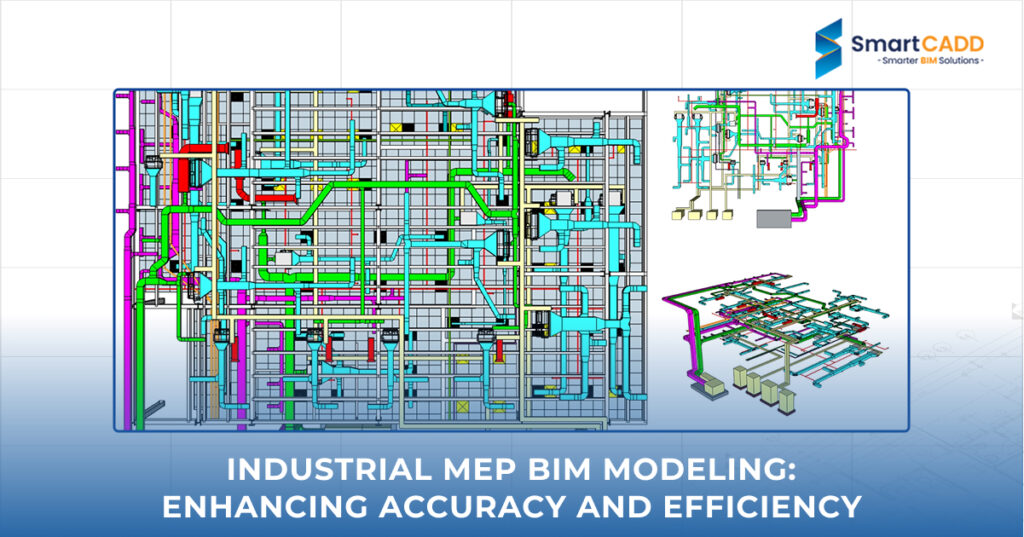

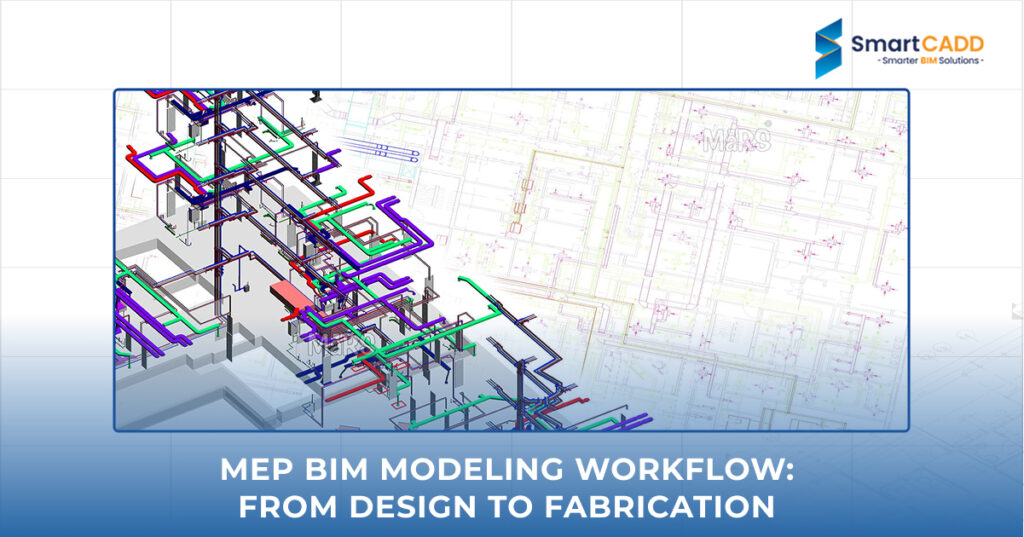

The construction industry is currently undergoing rapid transformations. This has made it more difficult to complete projects on time while keeping costs low. But in this field, MEP BIM Modeling has emerged as an essential way that helps to connect the initial design concepts to the physical fabrication of components. Through this modeling service, project teams can see on a screen how the Mechanical, Electrical and Plumbing (MEP) systems will fit into a building before any construction work begins.
In this guide, we will delve into the MEP BIM Modeling workflow and learn how it transforms complex construction projects into smooth and error-free operations.
What is MEP BIM Modeling?
The MEP BIM (Building Information Modeling) is a process of developing 3D models of buildings that contain detailed information about a building’s mechanical, electrical and plumbing systems. The engineers use MEP 3D modeling to see both the physical structure and operational functions of these systems, which cannot be seen clearly in traditional 2D drawings.
These MEP BIM Modeling designs contain more than just pictures. These designs provide vital information about every duct, pipe and electric circuit. Through this “intelligent” data, contractors can easily understand how the particular system will perform, how much more material will be required and how the different components will interact with the building’s other components.
Understanding coordination is crucial during preconstruction, our guide on What Contractors Should Expect from Professional MEP BIM Modeling Services explains how detailed modeling streamlines project delivery.
MEP BIM Coordination Process at SmartCADD
At SmartCADD, we follow a structured, step-by-step workflow to ensure that every MEP project is accurate and ready for the construction site. Our MEP coordination services eliminate the guesswork from the building construction process.
Review of Design Inputs
The process starts with the collection of all architectural documents and structural drawings. The team examines these materials to discover the project’s constraints and its objectives. This ensures that the MEP systems we have designed will fit perfectly in the building structure.
Development of Initial MEP BIM Models
Our team uses Revit software to create initial 3D models. With our MEP modelling services, we create precise models of all project components, including HVAC ducts, plumbing lines and electrical conduits.
Clash Detection
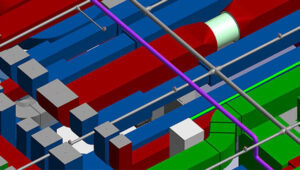
With our MEP clash detection services, we find interferences, often called hits, to create an error-free model. For example, our software shows an error if a water pipe mistakenly goes through a steel beam in the BIM design. Identifying these problems early on protects construction work from costly errors that may occur during the building process.
Coordination of MEP Components
After the clashes are identified, our team starts working on MEP BIM coordination. We adjust the routing of pipes and ducts to ensure everything fits in the available space. The 3D MEP coordination process creates an efficient work environment because it prevents plumbers and electricians from obstructing each other’s tasks.
For a deeper understanding of how coordination prevents costly clashes, read our article on Why MEP Coordination Is Important for Clash-Free BIM Models.
Finalising Construction Drawing Sets
After making the model clash-free and coordinated, we create detailed shop drawings. These drawings give exact measurements and locations to the field team so they can precisely install all the components.
Delivery
The final step is where we deliver a high-quality, data-rich 3D BIM Model and a complete set of coordinated drawings. This package, if implemented correctly, ensures that the project will be a success.
Key Benefits of a Streamlined MEP BIM Modeling Workflow
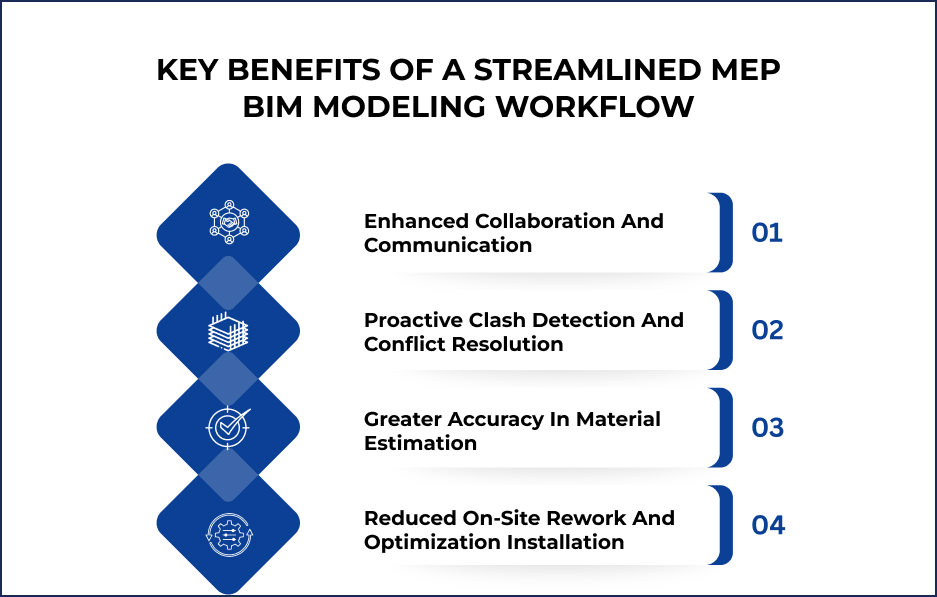
Adopting a digital BIM MEP coordination workflow offers great advantages to developers, architects and contractors alike.
Enhanced Collaboration and Communication
MEP BIM modeling acts as a “single source of truth”. The entire team uses a shared 3D model instead of creating separate paper drawings for their work. The system enables better communication between team members since it establishes a shared understanding from the beginning.
Proactive Clash Detection and Conflict Resolution
By using MEP Clash Detection, you can solve errors and problems on your computer rather than on the construction site. Moving a pipe inside a software is much cheaper than moving it at the actual construction site, after breaking a wall or pillar.
Greater Accuracy in Material Estimation
The 3D MEP BIM Modeling uses real-world dimensions, which enable us to generate precise “schedules” or material lists. This results in better budgeting and a decrease in material waste, which benefits both the environment and your business.
Reduced On-Site Rework and Optimization Installation
When the design is built with all the fabrication components in mind, then many of these components can be pre-built off-site. This modular system enables faster installation work and reduces the requirement for on-the-fly repairs, which results in safer and more organized job site conditions.
For a deeper understanding of integrated building services planning, read our Complete Guide to MEP Coordination in Building Projects.
Why SmartCADD is Your Trusted Partner for MEP BIM Modeling
Choosing the right partner for MEP BIM modeling services can make or break your project timeline. SmartCADD provides customers with complete design-to-fabrication services that significantly increase the success of your projects.
At SmartCADD, our team has extensive expertise in HVAC BIM coordination services and general MEP BIM coordination services. This enables us to assist clients worldwide in solving difficult engineering problems.
We don’t just offer drawings; we offer a partnership focused on accuracy and efficiency. SmartCADD uses advanced technology together with its expert MEP BIM Modeling team to optimize MEP systems for operational effectiveness, budget efficiency and installation readiness.
Conclusion
The process of developing a project from its first design stage to the last production stage needs both precise execution and thorough operational planning. The implementation of an all-encompassing MEP BIM Modeling workflow guarantees complete mechanical, electrical and plumbing system integration into the building design before construction starts.
By using a professional MEP BIM workflow, you can eliminate the risk of errors, reduce the cost of construction and ensure a high-quality result.