

Scan to BIM has changed the way we capture and use building data for construction and renovation. From large-scale infrastructure work in Sydney to heritage restoration projects in Melbourne, more engineers, architects, and contractors are choosing Scan to BIM to build the most accurate physical structures.
Here’s a look at the four biggest Scan-to-BIM trends in Australia.
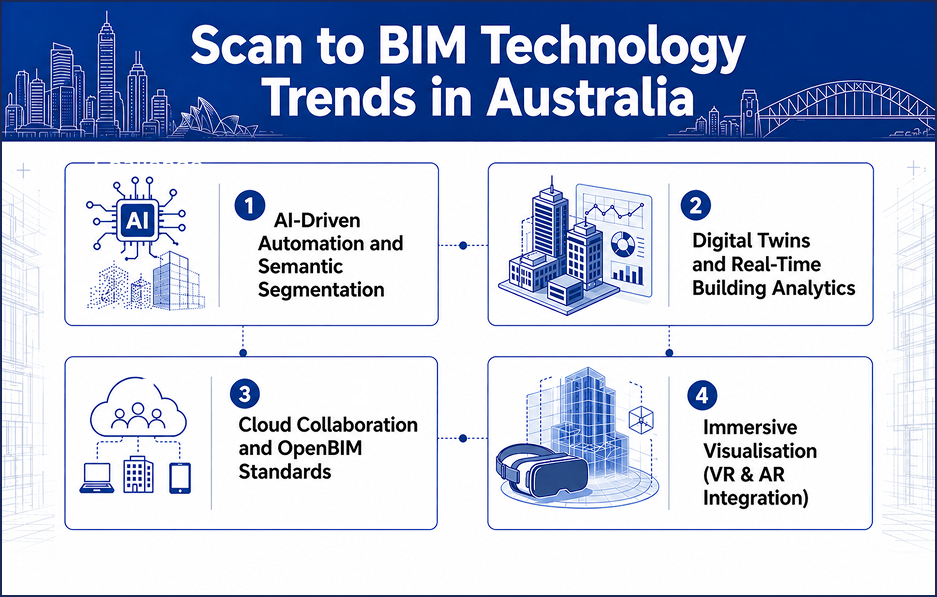
Trend 1: AI-Driven Automation and Semantic Segmentation
One of the most exciting developments we have seen in point cloud to BIM is the increased use of artificial intelligence. Not long ago, converting a laser scan into a workable BIM model was a slow, labour-intensive process. But today, AI has changed this entire process, and it has also made it fast.
Here’s how an AI-assisted, modern workflow actually looks:
Step 1: Intelligent Point Cloud Processing
Raw laser scans capture millions of data points, but not all of them are useful. Some of them are just noise, like reflective surfaces, equipment, or the sound of people walking through a scan. AI algorithms filter out this noise and provide us with a clean, accurate point cloud.
Step 2: AI-Powered Feature Extraction
Once the data is clean, machine learning identifies geometric patterns, such as walls, columns, beams, pipes and more. This allows professionals to do days of manual work in a very short amount of time.
Step 3: Parametric Object Generation
After extracting these features, the system converts them into Revit-ready BIM elements. All of these smart objects carry real data, and not just geometry.
Step 4: Human Verification
This is where an expert Scan to BIM service provider, like SmartCADD, helps to create the most accurate digital model. Experienced BIM professionals review every automated output before delivery, making sure the model is accurate and ready to use.
This combination of machine speed and human expertise is what separates quality Scan to BIM services in Australia from the rest.
Trend 2: Digital Twins and Real-Time Building Analytics
A BIM model doesn’t have to go quiet once construction ends. Digital twins keep it alive, connected, and working for your building long after the last brick is laid.
Beyond Construction
A point cloud to BIM model still proves to be very useful even after the construction is completed. This digital model helps professionals to plan their repair and renovation work easily because they would know where the wires, ducts, and BIM are present in the building.
Sustainability Goals
Digital twins are becoming a powerful tool for meeting Australia’s sustainability targets. They allow facility managers to monitor energy consumption, simulate different HVAC configurations, and track carbon outputs, all with the help of one single model.
The “Live” Model
Sensors installed in a building send data back into a BIM model in real time. This gives us a genuinely powerful model that tells us what changes are taking place at the very moment.
The particular feature helps maintenance teams to spot issues before they become expensive problems. Moreover, it also gives building owners all the important insights that were simply impossible to get a decade ago.
Explore how real-time asset tracking evolves further in our guide, How Digital Twins Empower Real-Time BIM Asset Management, for end-to-end lifecycle management.
Trend 3: Cloud Collaboration and OpenBIM Standards
The huge size of Australia makes construction difficult there. Teams working on a project in Perth might be collaborating with consultants in Brisbane, while their client could be sitting in Melbourne.
Cloud-based BIM platforms and OpenBIM standards, like IFC, really help to remove these barriers entirely from the work process.
Here’s how choosing BIM services in Australia helps project managers and their teams:
Precision: Modern laser scan to BIM services helps professionals to achieve ±2 mm accuracy, which is important for heritage projects and complex MEP (Mechanical, Electrical and Plumbing) installation.
Cost Control: With 5D BIM (that also includes Time and Cost-related data), professionals can generate more accurately how much material, labour and equipment they are going to require. This reduces the chances of budget expansion significantly.
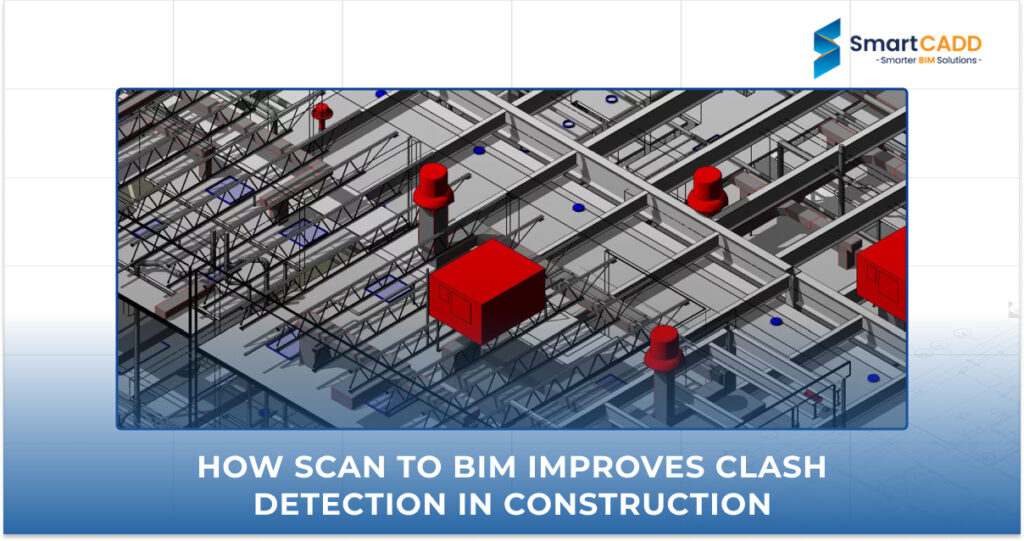
Risk Mitigation: The clash detection feature inside Scan to BIM models means teams can detect and resolve conflicts virtually, before it turns into a problem at the actual construction site.
Safety: 4D (Time-based) BIM allows teams to rehearse construction sequences virtually, through which they can identify safety risks before workers ever step on site.
Trend 4: Immersive Visualisation (VR & AR Integration)
From scan to BIM Sydney projects to large-scale developments in Adelaide, VR and AR are transforming how teams visualise, review, and build with complete confidence.
Virtual Walkthrough
Many times, clients and stakeholders don’t read technical drawings. In such a situation, they can just wear a VR headset and walk through a building before even a single brick is laid.
Today, Scan to BIM models can be easily exported into VR environments, making design reviews more intuitive than ever.
On-Site AR
Augmented reality takes it a step further. With AR glasses or a tablet, a site manager can place the 3D digital model right at the construction site on the screen. In this way, they can show their teams and clients exactly where a pipe should run or where a wall should be built. For 3D laser scanning services Sydney projects, this is becoming standard practice for complex projects.
Learn more about digital transformation in AEC through How AI is Transforming Scan to BIM: Key Trends & Technologies
Why SmartCADD is Your Trusted Partner for Scan to BIM in Australia?
When it comes to choosing a trusted BIM company Australia, SmartCADD stands in a league of its own. We have built our reputation on one simple principle: your model should work as hard as your team does.
We understand that no two projects are the same. Whether you need a heritage scan to BIM Australia for a sensitive restoration, a complete point cloud to BIM Australia conversion for a commercial refurbishment, or long-term BIM management for a large infrastructure project, SmartCADD has the expertise to deliver every time.
Our scan to BIM services Australia cover the full project lifecycle, right from initial 3D laser scanning through to Revit model delivery and beyond. Also, every model is thoroughly reviewed by our experienced BIM professionals before it reaches your desk.
Conclusion: Preparing for a Tech-First Future
Scan to BIM is no longer a service for only special projects. Today, it has become a standard way for Australian construction and facilities teams to capture, understand and manage their projects.
AI, digital twins, cloud collaboration and immersive visualisation are all pushing the technology forward, and the firms that are working with these trends now will have a real competitive edge in the years to come.